Website Content Strategy
Redesigning web content strategy for the Department of Earth and Planetary Sciences to bridge the gap between audience segments and strategic priorities.
Impact
+33%
NEWS ARTICLE VOLUME 2025 vS. 2024
+43%
WEBSITE USERS 2025 vs. 2024
+3
TRAFFIC SOURCES (Direct, ORGANIC, REFERRAL) 2025 vs. 2024

THE CHALLENGE
Bridging the gap between research and visibility
Existing EPS homepage prior to content strategy and structural recommendations.
Department of Earth and Planetary Sciences at UC Davis prioritized a strategic transformation to better communicate its global research impact. The existing site struggled with complex information architecture and a fragmented user journey that failed to highlight key research milestones.
My role involved conducting a comprehensive audit of their digital ecosystem, identifying pain points in content discoverability, and developing a structural web strategy that prioritized storytelling, research communication, and WCAG accessibility compliance.
Defining the architecture
The existing content structure was reorganized around seven core content pillars, creating clearer pathways for prospective students, donors, researchers, faculty, and the broader public.
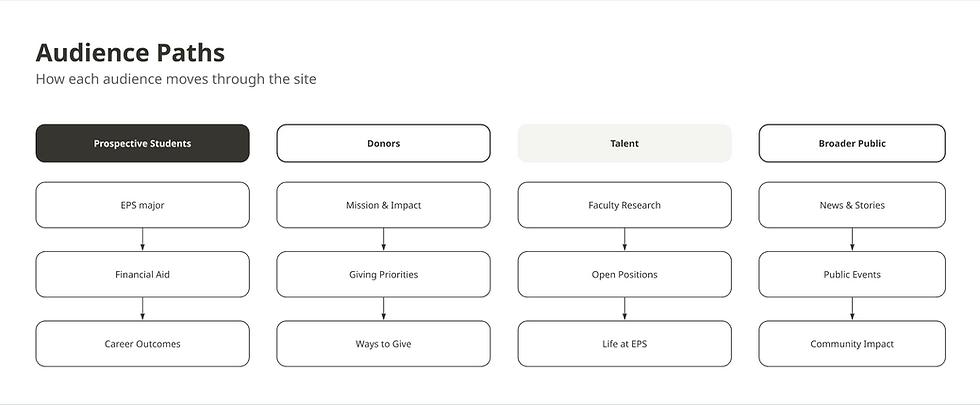
Content hierarchy
Making the homepage work harder.

Old homepage news section

New homepage news section
Tighter content · Clearer hierarchy · Stronger research visibility
The homepage was restructured to prioritize timely research, news, institutional storytelling while reducing visual clutter and creating clearer content hierarchy, and automating event updates to streamline ongoing content management.
Accessibility & content audit
Building accessibility into the content strategy.

Content and accessibility audit used to track issues, recommendations, ownership, and implementation status.
Accessibility considerations were incorporated into the content audit and structural recommendations, using WCAG guidelines to identify opportunities across content, navigation, headings, links, imagery, and page structure.
Additional work
Strategically published the new degree program on the department website.


Communicated program changes on the homepage
Alerted prospective students that the former program was no longer accepting new students.
Published updated advising resources
Launched a new advising page reflecting the revised program requirements and pathway to degree completion.
Built a dedicated navigation structure for the new major
Added the new program to the main menu, with supporting subpages to help prospective students navigate application requirements and related resources.
Elevated the new major on the homepage
Created a dedicated homepage content block to increase the program’s visibility and direct prospective students to key information.